
Wärmebox
- a fossil-free district heating plant on less than 400 m2
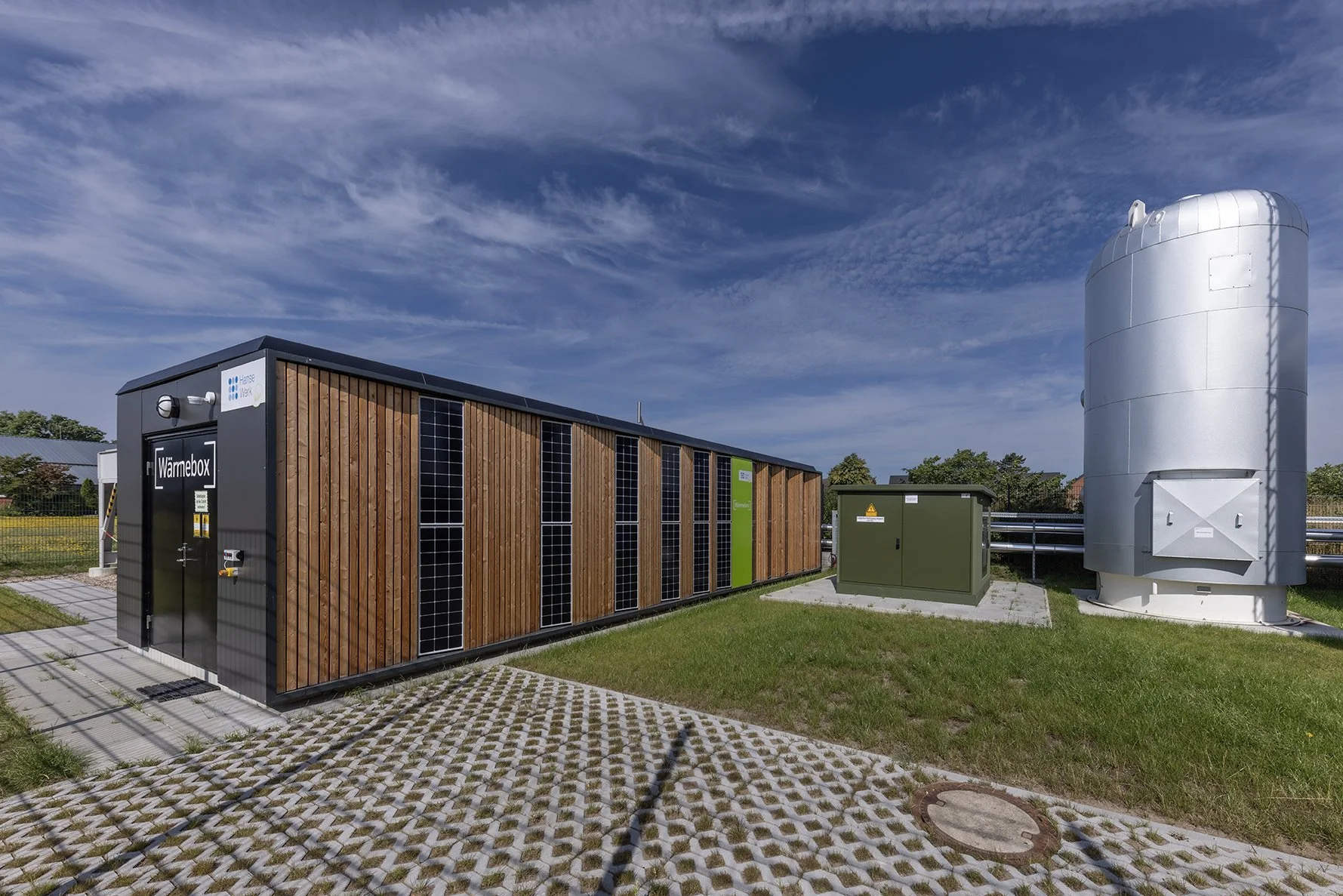
The Wärmebox/heat box developed in co-operation with HanseWerk Natur is a compact, modular and standardised solution for
district heating that brings large-scale, efficient heat pump technology within reach of smaller communities. The heat pump inside the
box draws on local energy sources – green electricity, ground, air and wastewater heat, plus industrial waste heat – to supply fossil-free, climate-neutral heating and cooling on demand to homes, public and office buildings.
The case
The Wärmebox in the village of Langenhorn, Northern Germany, was commissioned in October 2025 as the first of its kind - a heat pump the size of a garden shed, quietly supplying the small community with heat.
During the planning phase, the return temperatures from the heating grid were as high as 65°C – normal for Germany, but too high for CO2 refrigerant to perform efficiently. An isobutane sub-cooler was therefore included for direct sub-cooling of the CO2. As the grid operators successfully identified the consumers with the highest return temperatures and brought the overall return down to 40°C, conditions are now suitable for CO2 operation.
The installation has displaced gas from the local heating plant. It consists of four elements: the heat pump in a box, energy collectors (4 evaporators with 6 fans each), a small buffer tank and a transformer station – with a combined footprint of only about 400 m2. Installation was fast – all crane work to lift the elements into place was completed in a single day.
With Langenhorn in operation and many more planned, the town has become the starting point for a wider rollout starting from Northern Germany.
Year: 2025
Model: HHCI-900:
H-600 air-to-water heat pump
Integrated HCI-300 sub-cooler
Capacity: 900 kW
40°C/70°C (5°C/85% humidity)
Refrigerants: CO2 (R744)
Isobutane (R600a) for sub-cooling
Efficiency: SPF > 2.6 (measured from
January to September 2026)
The heat pump
The heat pump inside the box is a Fenagy H-600 air-to-water heat pump using CO₂ as refrigerant, built with an integrated HCI-300 isobutane sub-cooler for direct sub-cooling of the CO₂ right before expansion – useful whenever return temperatures are occasionally too high for CO₂ to operate efficiently on its own.
The unit runs with a low-pressure ejector for efficient part-load operation, a configuration also suited for combined heating and cooling and one that lets the heat pump sit close to its energy collectors, keeping pipework short and losses low.
Although the heat source of this installation is ambient air, the same platform can be adapted to extract heat from liquid sources such as river or sewage water. In principle, almost any waste heat or ambient source can be recovered and upgraded through the same technology.
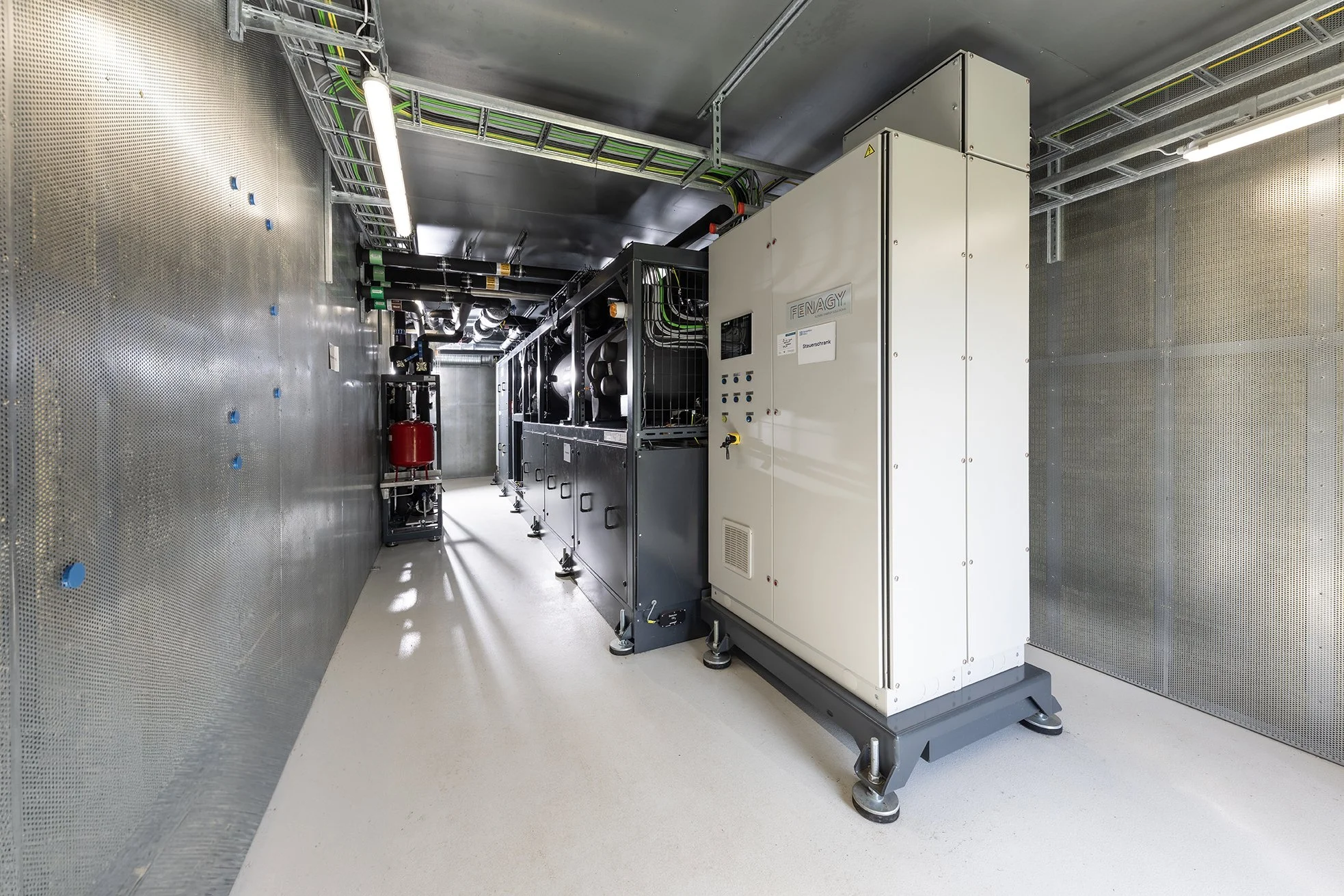
Heat pump rack with electrical panel and defrost module inside the heat box.
Quiet by design
The heat pump itself produces practically no sound emissions, thanks to its enclosed housing – the main source of noise is the fans and refrigerant flow in the evaporators. Acoustic screening was originally planned for the site but proved unnecessary: measurements showed the slow-running evaporator fans kept noise levels within the 35 dBA limit without additional screening.
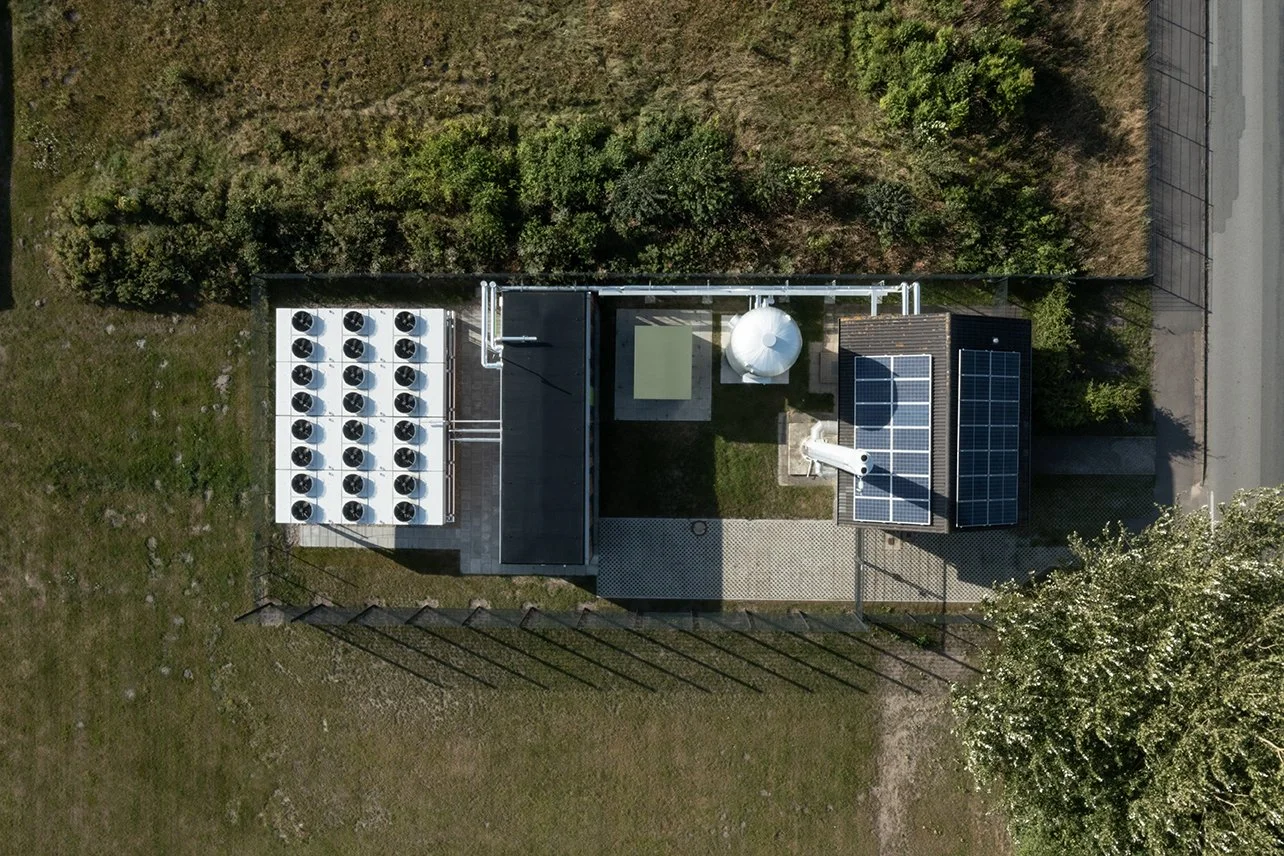
The new Langenhorn heat plant: energy collectors, heat pump in the heat box, transformer station and a small buffer tank.
Meeting Germany’s
efficiency requirement
From January to September 2026,
the Langenhorn heat pump delivered
a measured Seasonal Performance Factor (SPF) of more than 2.6 – reflecting both
low outdoor temperatures early in the
year and higher return temperatures
over summer.
With performance above 2.5, the heat
pump meets the efficiency threshold
for operating cost funding under Module
4 of Germany’s Federal Funding for
Efficient Heating Networks (BEW).
Final annual eligibility is determined
from the measured heat and electricity quantities for the calendar year.